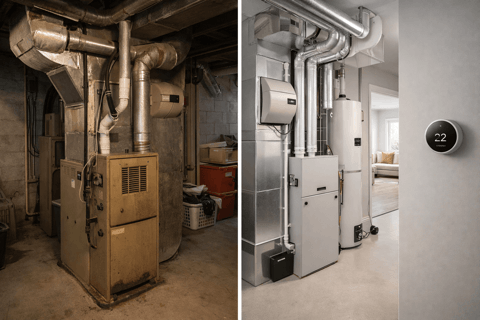
Quick Cost Answer: Furnace Replacement Cost Toronto vs Full HVAC Renovation
Most standard furnace-only replacements in Toronto/GTA are closer to $4,000-$8,000, while more complex HVAC renovation scenarios involving AC, ductwork, venting, gas/electrical changes, or older-home constraints can reach $10,000-$18,000+.
| Scenario |
Typical GTA Cost |
Notes |
| Basic furnace replacement | $4,000-$7,500 | Unit swap with limited extra scope. |
| Higher-efficiency furnace | $5,000-$10,000 | Better efficiency often raises equipment and setup cost. |
| Furnace installation with venting/gas/electrical adjustments | $6,000-$12,000 | Mechanical compatibility and code updates increase scope. |
| Furnace + AC replacement | $9,000-$16,000 | Shared labour can help, but still a major first-year cost for buyers. |
| Furnace + ductwork changes | $8,000-$18,000+ | Access, balancing, and routing complexity can escalate quickly. |
| Full HVAC modernization in an older Toronto home | $12,000-$25,000+ | Commonly includes mechanical, airflow, and access corrections together. |
| Heat pump / dual-fuel upgrade | Varies heavily | Depends on rebates, panel capacity, ductwork, and backup-heat design. |
Important: furnace-only replacement is not the same as full HVAC renovation.
Talk to professional
If the HVAC system looks old, unclear, or expensive to replace, get a realistic local quote before you assume the listing price is the real cost of the home.
Talk to professional
Ranges are practical planning ranges in CAD for Toronto/GTA. Actual quotes vary by verified site conditions, scope detail, and contractor design.
What Affects Furnace Renovation Cost in GTA?
- Furnace size and required BTU output for the home layout.
- Efficiency rating and equipment class (entry vs higher-efficiency models).
- Brand, warranty coverage, and part availability assumptions.
- Existing ductwork condition, sizing, leakage, and airflow balance.
- Venting path and whether chimney/venting changes are needed.
- Gas line updates, shutoff placement, and code corrections.
- Electrical and thermostat upgrades, including panel constraints.
- AC integration scope when cooling equipment is near end of life.
- Humidifier, air purifier, and filtration add-ons.
- Old Toronto home layout, basement access, and finished-ceiling constraints.
- Removal/disposal complexity and urgent winter replacement premiums.
- Ownership strategy: sale prep, active purchase, or long-term hold.
Real Furnace Renovation Scenarios in Toronto
- Basic furnace replacement: $4,000-$7,500 in many straightforward GTA installs.
- Higher-efficiency or partially constrained replacement: $5,000-$10,000.
- Furnace + AC replacement cost GTA scenarios: often around $9,000-$16,000.
- Old home HVAC replacement Toronto cases with duct/vent/electrical constraints: commonly $12,000-$25,000+.
How to Use This Calculator
- Pick the scope that best matches the current home condition.
- Use “No changes” where that component is acceptable today.
- Review low/high range and timeline before making an offer decision.
- Use the Get Matched flow for next-step partner routing.
When This Is Usually Manageable
- Replacement scope is clear and first-year budget reserve exists.
- Quotes separate furnace-only work from full HVAC renovation assumptions.
When Rough Estimates Break Down
- Mechanical scope is unclear but buyer budget has little margin.
- Old-home duct/vent/electrical constraints are ignored before offer pricing.
Furnace Replacement Cost vs HVAC Replacement Cost in Toronto
- Furnace replacement cost Toronto usually means replacing the heating unit only.
- HVAC replacement cost Toronto can include furnace, AC, heat pump, ductwork, controls, and correction work around venting/gas/electrical.
- If two quotes look far apart, they are often pricing different scopes.
Furnace Installation Price Toronto (2026 Ranges)
- Straightforward furnace installation price Toronto scenarios commonly fall around $4,000-$8,000 when the existing setup is compatible.
- Quotes can move higher when venting, gas line, electrical, thermostat, access, or ductwork corrections are included.
- A low furnace-only quote may exclude scope that a buyer still needs to budget for after inspection.
Old Toronto Homes: Why HVAC Quotes Can Jump
- Older ductwork can be undersized, leaky, or awkwardly routed.
- Finished basements often hide duct and venting constraints.
- Older electrical panels can limit upgrade options.
- Low basement ceilings can complicate distribution corrections.
- Chimney/venting updates can add cost unexpectedly.
- Previous DIY or partial renovations can create messy mechanical sequencing.
- Asbestos, moisture, or access limits can expand scope quickly.
- If the furnace is old but the rest of the home looks renovated, do not assume the HVAC system was properly modernized. Cosmetic renovations often leave core mechanical systems mostly untouched.
Repair or Replace the Furnace?
| Situation |
Better Option |
Why |
| Furnace under 10 years old, minor part issue |
Repair |
Usually the lowest-risk and lowest-cost move when service history is clean. |
| Furnace 15+ years old, frequent failures |
Replace |
Repeated repair costs can stack quickly while reliability drops. |
| Furnace works but is loud/inefficient |
Get inspection and quote |
Noise/comfort issues can signal sizing, airflow, or wear problems. |
| Buying a house with a 20+ year old furnace |
Budget replacement |
Treat as a likely first-year cost rather than a surprise. |
| Selling soon and furnace works |
Do not automatically replace |
Inspection + disclosure strategy may be better than full replacement spend. |
| Furnace + AC both old |
Price combined replacement |
Bundled planning reduces duplicate labour and repeat disruption. |
Furnace + AC Replacement Cost in Toronto
- Many furnace and AC replacement cost GTA scenarios fall around $9,000-$16,000.
- Replacing both together can reduce labour duplication, but it is still a meaningful first-year ownership expense.
- Buyers should check age and condition of both systems, not only whether the furnace turns on today.
- Older furnace plus older AC usually means budgeting for combined mechanical upgrades sooner than expected.
- Complex layouts, venting changes, and older-home constraints can push combined scope above the common range.
Heat Pump vs Furnace Replacement in Toronto
- Heat pumps can be attractive for integrated heating/cooling efficiency goals.
- Toronto winters may still require backup heat depending on system design and home envelope.
- Dual-fuel setups often combine heat pump plus furnace for cold-weather resilience.
- Heat pump vs furnace cost Toronto outcomes depend heavily on rebates, panel capacity, ductwork, insulation, and contractor design.
- Do not assume heat pumps are always cheaper or always better for every property.
- Read related context: what HVAC system is best Toronto, broader renovation planning, and first-year ownership budgeting.
Home Inspection Questions for HVAC
These questions do not replace a licensed HVAC inspection, but they help buyers decide whether to request a quote before offer, during a conditional period, or immediately after closing.
- How old is the furnace?
- Is there a service sticker or maintenance record?
- Is the furnace making unusual noise?
- Is there visible rust, leaking, or staining around the unit?
- Is the filter clean or neglected?
- Does the home heat evenly?
- How old is the AC?
- Are ducts accessible or hidden behind finished basement ceilings?
- Is the thermostat modern and functional?
- Is the electrical panel suitable for future HVAC upgrades?
- Are there signs of poor airflow in upper floors or basement rooms?
- Has the seller disclosed recent repairs?
Real Toronto/GTA Scenario
- A buyer walks into an older GTA home that looks cosmetically updated: fresh paint, newer floors, clean kitchen, finished basement.
- The furnace turns on, so it feels like the mechanical systems are fine.
- Inspection then shows the furnace is roughly 18-22 years old, the AC is near end of life, finished-basement ductwork is hard to access, and second-floor airflow is weak.
- The buyer does not automatically walk away, but should not treat this as a zero-cost issue.
- A realistic first-year HVAC budget can move from maybe $5,000 someday to $12,000-$18,000 when furnace, AC, venting, and airflow corrections are handled together.
When This Cost Matters Most in a Home Purchase
| Scenario |
Priority |
Why |
| Buying with no renovation budget |
High |
Mechanical surprises can destabilize first-year ownership cash flow. |
| Buying an older detached house |
High |
Legacy ducting, venting, and panel constraints are more common. |
| Buying a flipped-looking house |
High |
Cosmetic upgrades do not guarantee mechanical modernization. |
| Buying a condo |
Usually lower |
Depends on whether HVAC is owner-controlled or building-managed. |
| Buying a townhouse |
Variable |
Importance depends on individual system ownership and age. |
| Planning to sell soon |
Medium |
Inspection/disclosure strategy can matter more than full replacement. |
| Planning long-term ownership |
High |
Efficiency, reliability, and phased upgrade planning matter more over time. |
Buyer Shortcut
- For buyers, an old furnace is rarely a reason to panic by itself, but it should be priced into the offer when age, maintenance history, or inspection findings suggest replacement is likely soon.
Talk to professional
- If the HVAC system looks old, unclear, or expensive to replace, get a realistic local quote before assuming the listing price is the real cost of the home.
FAQ
How much does furnace replacement cost in Toronto?
Most standard furnace replacements in Toronto/GTA fall around $4,000-$8,000. Higher-efficiency systems, venting changes, gas/electrical work, or difficult access can push the cost higher.
How much is furnace installation in Toronto?
Many straightforward Toronto furnace installation projects land around $4,000-$8,000, while complex older-home installs with venting, gas, electrical, or ductwork corrections can move higher.
What is included in furnace installation price vs replacement price?
Installation price may focus on placing and connecting the new furnace. Replacement pricing can include removal, disposal, venting updates, thermostat work, duct adjustments, permits or inspection, and code corrections.
Why do Toronto furnace installation quotes vary so much?
Quotes vary because homes differ in furnace size, venting path, duct condition, gas/electrical readiness, access, emergency timing, and whether AC or heat pump work is bundled.
How much does a new furnace cost in Toronto?
A new installed furnace is commonly in the $4,000-$10,000 range depending on size, efficiency, brand, installation complexity, and whether other HVAC components are being changed.
How much does furnace and AC replacement cost in the GTA?
Many furnace + AC replacement projects land around $9,000-$16,000, but older homes, ductwork changes, or electrical/venting upgrades can increase the budget.
Is furnace renovation cost the same as furnace replacement cost?
Not exactly. Furnace replacement usually means replacing the unit. Furnace renovation or HVAC renovation can include ductwork, AC, thermostat, humidifier, filtration, venting, gas, electrical, and old-home corrections.
Should I replace the furnace before selling my house?
Not always. If the furnace works and is safe, replacing it before selling may not return full value. But if it is very old, unsafe, or likely to fail inspection, get a quote and decide whether to replace, disclose, or price accordingly.
Should I worry about an old furnace when buying a house?
Yes, but it is usually a budgeting issue, not an automatic deal-breaker. Ask for age, maintenance history, and inspection comments, then estimate whether replacement should be immediate, within one year, or later.
Is a heat pump better than a furnace in Toronto?
It depends on the home. Heat pumps can make sense, especially with cooling needs and efficiency goals, but older homes may need ductwork, electrical, insulation, or backup heat considerations.
Decision Intelligence for Toronto Buyers
Use these practical filters to decide what matters now, what can wait, and where budget risk is actually concentrated.
Timeline Impact
Not every scope is urgent. Prioritize timing by risk and occupancy needs.
- Fix before move-in: Safety, active leaks/moisture, and heating reliability should be handled first.
- Can wait 6–12 months: Most non-critical finish and comfort upgrades can be phased after stabilization.
- Long-term upgrades: Premium aesthetic upgrades are best timed after core systems are proven stable.
Cash-Flow Impact
Protect first-year liquidity by modeling renovation and ownership costs together.
- First-year pressure: Toronto buyers often face stacked costs: closing, immediate fixes, and carrying costs at once.
- Mortgage + renovation overlap: A “good deal” can become stressful when renovation draws from emergency reserves too early.
- Risk scenario: Always test a high-scope case with contingency before committing.
What to Fix First
Use a practical sequence so budget goes to risk reduction first.
- Must-do first: Safety, moisture, active system failures, and occupancy blockers.
- Can delay: Mid-priority functionality upgrades that do not create compounding damage.
- Optional improvements: Purely aesthetic upgrades after core stability is secured.
Planning Notes
Risks
Use a contingency because inspection findings and hidden conditions can expand scope quickly.
Trade-Offs
A lower purchase price can be offset by higher correction scope if timing and dependencies are underestimated.
When Not to Do It
Do not proceed when this estimate plus contingency removes your affordability margin.
About This Analysis
Toronto Buyer Research Team focuses on analyzing renovation cost ranges, scope complexity, and decision risk across GTA housing.
We do not provide quotes or services - only structured analysis to support buyer decisions.