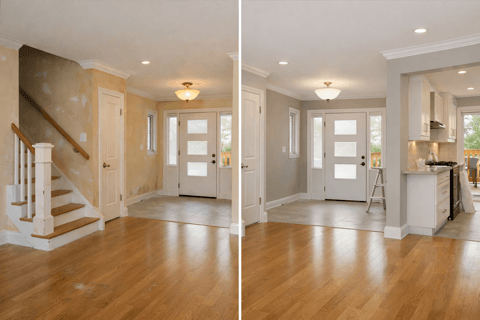
In Toronto, practical pre-purchase repair-and-refresh plans often run from $8,000 to $60,000 depending on trade mix and urgency. Most imperfect homes do not need full renovation right away, but stacked first-year fixes can strain cash flow if they are not prioritized. The right approach is to separate safety and systems corrections from cosmetic upgrades. For buyers across the GTA, this usually turns uncertainty into a manageable phased plan.
Why "General Repairs" Are Usually Manageable
- Most scopes are bundles of smaller tasks, not one huge reconstruction job.
- Safety-first sequencing keeps risk down: electrical/plumbing first, finishes second.
- A focused refresh often improves daily comfort and buyer confidence quickly.
Typical GTA Cost Range (Planning-Level)
Light repair package: about $3,000-$12,000 (patching, touch-up paint, small fixture fixes).
Balanced repair + refresh: about $12,000-$45,000 (paint + targeted electrical/plumbing + flooring/trim in key areas).
Large multi-area scope: about $45,000-$120,000+ when several systems and surfaces are addressed together.
Ranges are rough planning estimates in CAD for GTA and not contractor quotes.
Typical Timeline
- Small scope: 1-2 weeks
- Balanced scope: 2-6 weeks
- Larger multi-trade scope: 4-10+ weeks
Cost-Effective "Wow" Additions
- Fresh paint + updated hardware: immediate visual lift.
- Targeted lighting refresh: stronger perceived quality at moderate budget.
- Flooring in highest-traffic zones: visible improvement without full-home replacement.
Use the General Home Renovation & Repairs Calculator for a practical range before requesting quotes.
Where These Numbers Come From
These estimates are based on:
- aggregated contractor pricing across GTA
- observed listing patterns
- renovation scope scenarios typical for Toronto housing stock
Confidence Level
Confidence: Medium
Scope variability, hidden conditions behind walls, and dependency on inspection results can materially change final project depth and cost.
What Can Go Wrong
Common failure points:
- hidden moisture damage
- outdated electrical systems
- structural issues not visible during viewing
When This Estimate Breaks
This estimate breaks when:
- structural issues are discovered
- major system replacement is required
- layout changes trigger full renovation scope
Section 1 - Context
This page helps you decide whether this specific issue in a Toronto/GTA property is a manageable correction or a risk that can change deal viability.
Section 2 - Cost Range
Keep the existing ranges on this page unchanged and use them as scenario bounds, not single-point assumptions.
Section 3 - Interpretation
At the low end, work is usually selective and operational. At the high end, scope often shifts toward major systems, envelope, or layout complexity.
What this means in practice: use lower-range scenarios for phased fixes, and higher-range scenarios for deal-viability stress testing.
Section 4 - Risk & Variability
- Condition uncertainty before inspection and opening finishes.
- Trade coupling (electrical/plumbing/HVAC) that expands project scope.
- Permit, code, and sequencing requirements that add duration and cost.
Where this becomes a problem: when uncertainty sits in core systems, not just visible finishes.
Section 5 - What Can Go Wrong
- Hidden moisture or structural defects.
- Outdated service capacity requiring panel/mechanical upgrades.
- Scope assumptions that fail once contractor validation starts.
Section 6 - Confidence
Confidence: Medium
Confidence is medium because real scope is highly condition-dependent and can only be partially inferred from visible surfaces.
Section 7 - Decision Frame
When this is manageable: Manageable when inspections validate core systems and phased execution fits your first-year cash flow.
When to walk away: Walk away when unresolved structural/system risk stacks across multiple categories and erodes affordability.
When this changes your decision: when projected correction cost materially weakens total affordability after closing.
Section 8 - Next Step
Estimate your scenario first - then decide next step.
Need a full renovation budget baseline? Use the Toronto renovation cost checklist for a full renovation budget breakdown before you commit.
Planning Notes
Risks
Hidden conditions can shift a manageable project into a system-level correction if scope is not validated early.
Trade-Offs
Short-term savings on purchase price can be lost if first-year correction sequencing is underestimated.
When Not to Do It
Do not proceed when multiple high-cost corrections overlap and contingency cannot be absorbed.
Decision Intelligence for Toronto Buyers
Use these practical filters to decide what matters now, what can wait, and where budget risk is actually concentrated.
What to Fix First
Use a practical sequence so budget goes to risk reduction first.
- Must-do first: Safety, moisture, active system failures, and occupancy blockers.
- Can delay: Mid-priority functionality upgrades that do not create compounding damage.
- Optional improvements: Purely aesthetic upgrades after core stability is secured.
Cash-Flow Impact
Protect first-year liquidity by modeling renovation and ownership costs together.
- First-year pressure: Toronto buyers often face stacked costs: closing, immediate fixes, and carrying costs at once.
- Mortgage + renovation overlap: A “good deal” can become stressful when renovation draws from emergency reserves too early.
- Risk scenario: Always test a high-scope case with contingency before committing.
Negotiation Impact
Use issue evidence to negotiate based on scope realism, not fear.
- When it helps negotiation: Toronto buyers usually get leverage when scope is measurable (inspection-backed systems, moisture, electrical, HVAC).
- When it does not help: Purely cosmetic issues with many comparable listings rarely produce large concessions.
- Toronto reality: Vendors may hold firm in tight sub-markets, so your strongest leverage is a clear CAD scope and timeline impact.
About This Analysis
Toronto Buyer Research Team focuses on analyzing renovation cost ranges, scope complexity, and decision risk across GTA housing.
We do not provide quotes or services - only structured analysis to support buyer decisions.