Quick answer
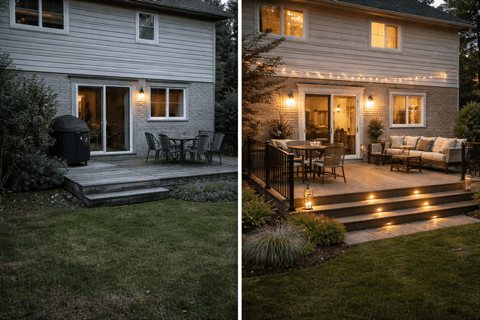
In Toronto, backyard deck projects often range from about $9,000 to $40,000, while larger custom scopes can cost more. For buyers evaluating weak outdoor space, this is usually a manageable improvement rather than a core property risk. Cost depends on structure, height, railing complexity, access, and permit requirements, not just deck size. The practical decision is whether a staged deck plan fits your first-year budget and expected home use.
What this looks like in Toronto and GTA neighborhoods
Urban Toronto lots may have tighter setbacks and access limits, while suburban GTA lots offer more footprint flexibility but can still require drainage and permit planning. Ontario weather exposure makes material selection a lifecycle decision, not just a visual one.
Typical GTA deck cost ranges (CAD)
- Simple platform deck: $9,000-$20,000
- Mid-scope with rails/stairs/lighting: $20,000-$45,000
- Large custom scope: $45,000-$90,000+
Typical timeline: 2-8 weeks including planning, permit coordination where required, and build.
Decision framework
- Confirm drainage and structural attachment feasibility.
- Price a minimum viable deck scope before writing the offer.
- Add optional wow-features only after core usability is funded.
Related planning links
Where These Numbers Come From
These estimates are based on:
- aggregated contractor pricing across GTA
- observed listing patterns
- renovation scope scenarios typical for Toronto housing stock
Confidence Level
Confidence: Medium
Scope variability, hidden conditions behind walls, and dependency on inspection results can materially change final project depth and cost.
What Can Go Wrong
Common failure points:
- hidden moisture damage
- outdated electrical systems
- structural issues not visible during viewing
When This Estimate Breaks
This estimate breaks when:
- structural issues are discovered
- major system replacement is required
- layout changes trigger full renovation scope
Section 1 - Context
This page helps you decide whether this specific issue in a Toronto/GTA property is a manageable correction or a risk that can change deal viability.
Section 2 - Cost Range
Keep the existing ranges on this page unchanged and use them as scenario bounds, not single-point assumptions.
Section 3 - Interpretation
At the low end, work is usually selective and operational. At the high end, scope often shifts toward major systems, envelope, or layout complexity.
What this means in practice: use lower-range scenarios for phased fixes, and higher-range scenarios for deal-viability stress testing.
Section 4 - Risk & Variability
- Condition uncertainty before inspection and opening finishes.
- Trade coupling (electrical/plumbing/HVAC) that expands project scope.
- Permit, code, and sequencing requirements that add duration and cost.
Where this becomes a problem: when uncertainty sits in core systems, not just visible finishes.
Section 5 - What Can Go Wrong
- Hidden moisture or structural defects.
- Outdated service capacity requiring panel/mechanical upgrades.
- Scope assumptions that fail once contractor validation starts.
Section 6 - Confidence
Confidence: Medium
Confidence is medium because real scope is highly condition-dependent and can only be partially inferred from visible surfaces.
Section 7 - Decision Frame
When this is manageable: Manageable when inspections validate core systems and phased execution fits your first-year cash flow.
When to walk away: Walk away when unresolved structural/system risk stacks across multiple categories and erodes affordability.
When this changes your decision: when projected correction cost materially weakens total affordability after closing.
Section 8 - Next Step
Estimate your scenario first - then decide next step.
Need a full renovation budget baseline? Use the Toronto renovation cost checklist for a full renovation budget breakdown before you commit.
Planning Notes
Risks
Hidden conditions can shift a manageable project into a system-level correction if scope is not validated early.
Trade-Offs
Short-term savings on purchase price can be lost if first-year correction sequencing is underestimated.
When Not to Do It
Do not proceed when multiple high-cost corrections overlap and contingency cannot be absorbed.
Decision Intelligence for Toronto Buyers
Use these practical filters to decide what matters now, what can wait, and where budget risk is actually concentrated.
Resale Impact
Think one buyer cycle ahead: what future buyers will notice first.
- Does it affect resale?: Yes, especially when daily usability or perceived maintenance risk remains unresolved.
- Cosmetic vs structural: Cosmetic drag often lowers perceived value; structural/mechanical uncertainty lowers buyer confidence more aggressively.
- Buyer psychology: Homes that feel “predictable to own” usually resell better than homes that feel uncertain.
Negotiation Impact
Use issue evidence to negotiate based on scope realism, not fear.
- When it helps negotiation: Toronto buyers usually get leverage when scope is measurable (inspection-backed systems, moisture, electrical, HVAC).
- When it does not help: Purely cosmetic issues with many comparable listings rarely produce large concessions.
- Toronto reality: Vendors may hold firm in tight sub-markets, so your strongest leverage is a clear CAD scope and timeline impact.
Timeline Impact
Not every scope is urgent. Prioritize timing by risk and occupancy needs.
- Fix before move-in: Safety, active leaks/moisture, and heating reliability should be handled first.
- Can wait 6–12 months: Most non-critical finish and comfort upgrades can be phased after stabilization.
- Long-term upgrades: Premium aesthetic upgrades are best timed after core systems are proven stable.
About This Analysis
Toronto Buyer Research Team focuses on analyzing renovation cost ranges, scope complexity, and decision risk across GTA housing.
We do not provide quotes or services - only structured analysis to support buyer decisions.